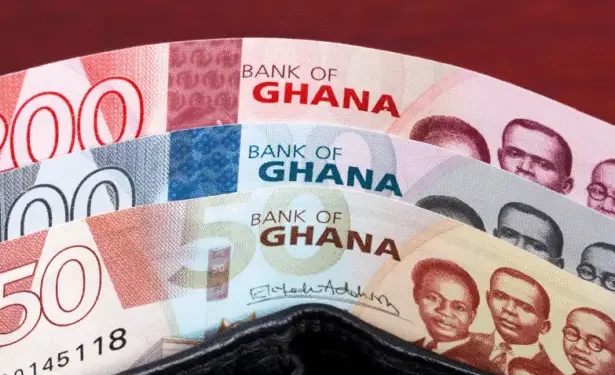
According to the World Bank’s October 2026 Africa Economic Update, the cedi recorded the largest maximum weakening among the currencies tracked, in the survey which examines exchange-rate movements following the escalation of the conflict in the Middle East.
It was followed by the currencies of Lesotho, Namibia, South Africa and Eswatini, which each recorded maximum weakening of roughly 7 percent.
The Seychelles rupee also came under significant pressure, weakening by almost 7 percent, while the currencies of the Democratic Republic of Congo and Uganda recorded maximum declines of about 6 percent and 5 percent respectively.
Other currencies, including those of Botswana, Zambia and Mauritius, recorded comparatively smaller periods of maximum weakening, generally ranging between about 3 percent and 5 percent.
The World Bank notes that the depreciation pressures were broad-based across the region.
“Most countries with available daily exchange rate data recorded currency depreciations during the second quarter of 2026 relative to end-February, before the conflict intensified. In seven of the 22 countries monitored (excluding the CFA franc zone), the maximum depreciation exceeded 5.0%, including in the Democratic Republic of Congo, Ghana, the Seychelles, and South Africa.”
The World Bank attributes the pressure on African currencies partly to the sharp increase in oil and energy prices following the escalation of the Middle East conflict.
Higher energy prices increased import bills, particularly for net energy-importing economies, raising demand for U.S. dollars, weakening foreign exchange positions and intensifying depreciation pressures.
The report also points to heightened geopolitical uncertainty, which triggered a flight to safety in global financial markets and encouraged capital reallocation away from emerging and frontier economies.
For countries with significant external debt obligations, currency depreciation also increased the local-currency cost of servicing U.S. dollar-denominated debt, adding to fiscal pressures.
Cedi recovers some ground by August
Despite recording the largest maximum weakening between March and June, the cedi recovered some ground by August.
Figure 1.24 shows that the cedi remained weaker than its end-February level by the end of August, although the depreciation had eased considerably from its peak.
The World Bank notes that much of the pressure on African currencies had eased by the end of August, with only 10 currencies remaining weaker than their end-February levels.
“By end-August, however, much of this pressure had eased, with only 10 currencies remaining weaker than their end-February levels.”
The report says the impact of the shock was not uniform across Sub-Saharan Africa.
Countries heavily dependent on energy imports, with limited foreign exchange buffers and elevated debt-service burdens, faced stronger pressures.
By contrast, economies with strong commodity exports proved more resilient.
South Africa, for instance, benefited from stronger demand for gold and platinum, which supported foreign exchange earnings despite heightened risk aversion.
Oil exporters such as Angola and Nigeria also benefited from higher crude oil prices, which boosted export receipts and provided additional foreign currency inflows, helping to cushion exchange-rate pressures.
Overall, the cedi’s performance stands out in the World Bank’s comparison, recording the sharpest maximum exchange-rate weakening among the currencies tracked between March and June 2026, before recovering some of those losses by August.
Leave a Comment
No comments yet. Be the first to comment!