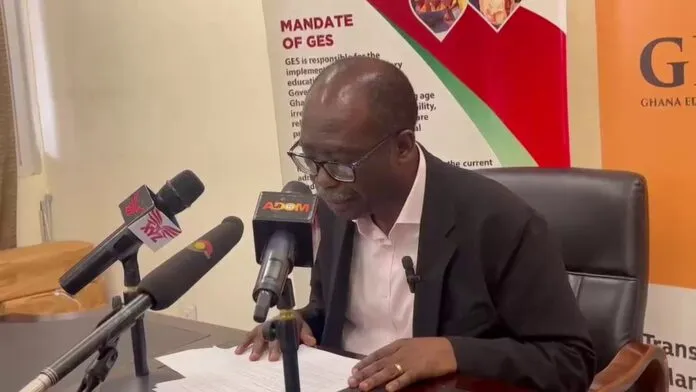
Director-General of the GES, Professor Ernest Kofi Davis, said the industrial action could threaten the stability of the academic calendar, which he described as a major achievement after years of disruptions.
Speaking at a press briefing on Tuesday, September 29, Professor Davis said the government was working with the Ministry of Education, Ministry of Labour, the Controller and Accountant-General’s Department and other stakeholders to address the issues raised by the unions.
He urged the unions to reconsider their decision and allow the ongoing engagements to continue.
“We wish to associate ourselves therefore with the Ministry of Education’s appeal to teachers to rescind their decision as we work hard to address their issues,” he said.
According to Professor Davis, the 2026/27 academic year represents a significant step towards restoring predictability to Ghana’s education system.
He noted that, for the first time in about six years, students across the various levels of pre-tertiary education reported to school within September, describing the development as the result of sustained efforts to restore stability to the academic calendar.
“For the first time in approximately six years, we have reached a point where students across the various levels of our education system have reported to school within September. This did not happen by accident. It was achieved through hard work,” he said.
He explained that the synchronised academic calendar was important not only for schools but also for parents and other stakeholders, as it allowed them to plan around clearly defined academic timelines.
Professor Davis also cited measures undertaken by the GES to improve conditions for teachers, including the mechanisation of promotions, while assuring educators that the Service remained committed to meeting its obligations.
The GES Director-General acknowledged that challenges remained but said maintaining the stability of the academic year must be a shared responsibility.
The strike by the Ghana National Association of Teachers (GNAT), National Association of Graduate Teachers (NAGRAT) and the Pre-Tertiary Teachers Association of Ghana (PRETAG) began on September 25.
The unions are demanding the payment of outstanding promotion arrears, progress on negotiations for a new Collective Agreement and the implementation of the Deprived Area Allowance, among other concerns.
The industrial action comes less than two weeks after the commencement of the new academic year, with the GES warning that prolonged disruption could affect efforts to maintain the restored academic calendar.
Leave a Comment
No comments yet. Be the first to comment!