The Institute of Statistical, Social and Economic Research (ISSER) says the shortfall limits the government’s capacity to finance development and could increase pressure to rely on expenditure cuts.
The warning comes as the economy strengthens and the government works to consolidate the fiscal gains recorded in 2025, raising the question of whether domestic revenue can keep pace with the country’s expanding spending and investment needs.
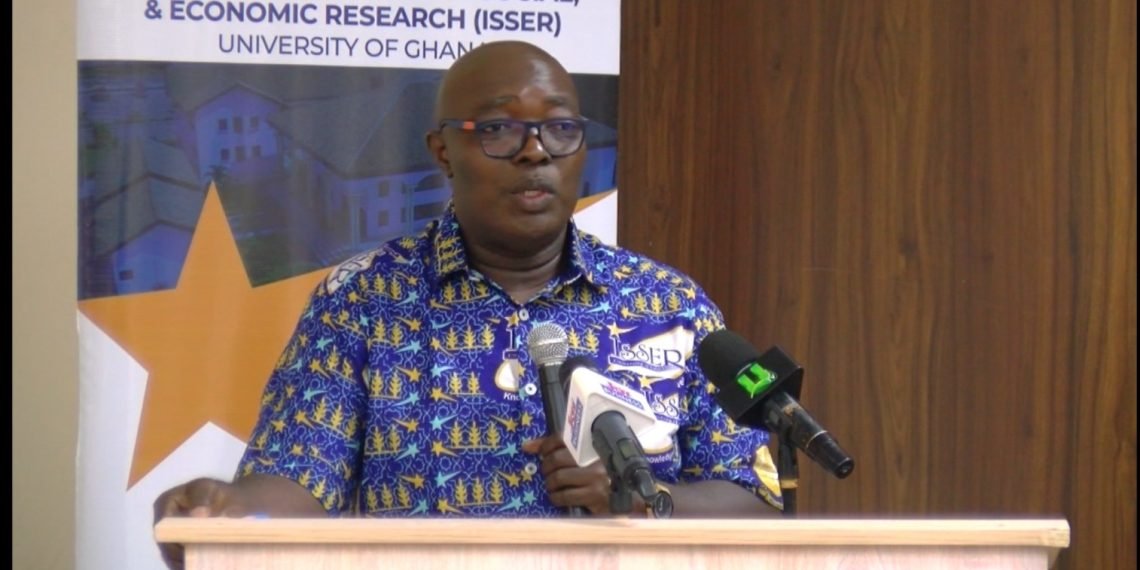
Presenting the State of the Ghanaian Economy Report 2025 released by ISSER, the director of the Institute Professor Robert Darko Osei said Ghana’s tax revenue was about 30% of GDP in 2025, below the sub-Saharan African average, pointing to a revenue mobilisation gap that needs to be addressed if the country is to sustain stronger growth.
“Our revenue effort is a bit low. In fact, tax revenue is under 30% in 2025, was about 30% of GDP, and that was significantly lower than that which pertains in sub-Saharan Africa,” Professor Osei said at the launch of ISSER’s State of the Ghanaian Economy Report 2025.
He argued that closing the gap will require expanding the tax base rather than placing additional pressure on those already within the formal tax system.
“What it then points to is the need for bringing more into the tax net as it were, so that the revenue effort can be improved,” he said.
Professor Osei also flagged the implications of Ghana’s planned economic rebasing, which he said could push the tax-to-GDP ratio lower unless revenue collection rises alongside the expansion of the measured economy.
He asserts that the issue is particularly important because the improvement in Ghana’s fiscal position in 2025 did not come from a significant increase in revenue mobilisation.
Revenue and grants remained broadly unchanged relative to GDP, while expenditure consolidation accounted for much of the fiscal adjustment.
Professor Osei added that the country therefore needs to rethink its spending priorities while strengthening domestic revenue mobilisation.
He also pointed to Ghana’s relatively high average tariff rates compared with other countries in the sub-region, reinforcing the need to broaden the domestic tax base rather than depend disproportionately on existing revenue sources.
“However the average tariff rates in Ghana is significantly higher than that in the sub-region what it then points to is the need for bringing more into the tax net as it were so that the revenue effort can be improved,”
For Ghana, the challenge is increasingly shifting from restoring macroeconomic stability to creating enough fiscal space to finance the next phase of growth.
ISSER’s assessment suggests that without a broader and more productive tax base, stronger headline growth may not automatically translate into greater capacity to fund infrastructure, jobs and economic diversification.
Leave a Comment
No comments yet. Be the first to comment!