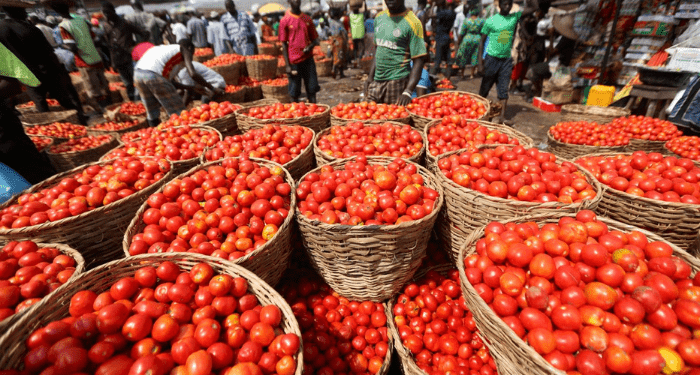
The Food and Beverages Association Ghana (FABAG) has expressed strong concern over the ongoing tomato supply crisis, following Burkina Faso’s ban on tomato exports to Ghana.
In a press release, FABAG described the situation as a clear indication of weaknesses, poor planning, and policy failures within Ghana’s agricultural sector.
The Association said Ghana’s continued reliance on imports for a basic commodity like tomatoes is unacceptable, despite the country’s vast agricultural resources.
“This situation has once again exposed the dangerous weakness, poor planning, and policy failure within Ghana’s agricultural sector. It is completely unacceptable that a country with vast agricultural land, irrigation dams, agricultural colleges, research institutions, extension officers, and a full Ministry of Food and Agriculture cannot produce enough tomatoes to feed its own population and must depend on another country for such a basic food commodity,” the statement said.
FABAG added that if the Ministry of Food and Agriculture is unable to coordinate nationwide tomato production within the next two to three months, the government should consider restructuring it into a more production-focused institution with clear targets and accountability.
“FABAG wishes to state clearly and without apology that if the Ministry of Food and Agriculture cannot mobilize the country to produce tomatoes within two to three months, then the Ministry has failed in its core mandate and has no justification to continue to exist in its current form.”
The Association argued that tomatoes are a short-cycle crop that can be cultivated and harvested within 60 to 90 days, stressing that with proper planning and irrigation, Ghana could produce the commodity multiple times a year.
It maintained that the country has the capacity to address the current shortage within a short period if the right measures are implemented.
FABAG further noted that Ghana has fertile land, irrigation infrastructure, research institutions, extension officers, and access to inputs such as improved seeds, fertilisers, and mechanisation services, yet continues to face production challenges. According to the Association, this points to issues of leadership and policy direction rather than a lack of resources.
The group warned that reliance on other countries for essential food items poses a national security risk and urged the government to take urgent steps to boost local production.
As part of its recommendations, FABAG called for the declaration of a national emergency tomato programme, the distribution of improved seeds, provision of subsidised inputs, activation of irrigation systems, and the mobilisation of youth into commercial tomato farming. It also proposed support for greenhouse production, revival of tomato processing factories, and investment in storage and transportation to reduce post-harvest losses.
The Association further urged the government to set a target for Ghana to achieve tomato self-sufficiency within one year, stressing the need to shift from policy discussions to practical results in food production.
Burkina Faso ban exposes Ghana’s tomato production weaknesses – FABAG
Business
•
•
38 views
4 weeks ago
citinewsroom



Discussion
0 commentsJoin the conversation
No comments yet. Be the first to share your thoughts!